
Monday, January 11, 2016
Fun new tool
Learning new pollen types is a fun, but arduous process. The MSU Paleoecology Lab recently acquired a new tool that will make it much easier for palynologists to learn. The dual scope allows two people to view the same slide. A neat feature is the "pointer" giving one person the ability to point to specific objects on the slide.

Sunday, January 10, 2016
Notes from the field: Argentina
Paleoecology Lab Director, Dr. Cathy Whitlock and Ph.D student Buzz Nanavati hit the skies this last week for the southern hemisphere. They are traveling to San Carlos de Bariloche, Argentina for a conference titled "Modeling past and present vegetation dynamics in Patagonia forest-steppe". Those gathered are from the fields of ecosystem modeling, paleoecology, and archaeology. Buzz has shared some beautiful photos of the area.
After the conference, Buzz and Dr. Whitlock will embark on a field excursion to retrieve lake sediment cores for Buzz's Ph.D dissertation. Check back for more notes from the field!
 |
| The region around Bariloche. |
 |
| The view from Buzz's room in Bariloche! |
Wednesday, December 30, 2015
Fairy Lake Vegetation Survey
Being a paleoecologist has many wonderful benefits. One of them is spending time outdoors in beautiful places. After retrieving a sediment core from Fairy Lake, James Benes and others returned to the area to conduct a vegetation survey. The survey helps James understand the modern pollen record found in the top layers of the lake sediment core. Another beautiful day in the Bridgers!


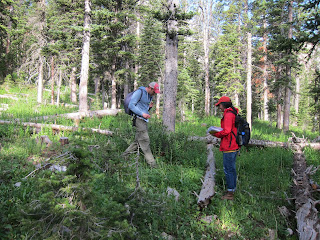


Fairy Lake
Spending the day on Fairy Lake in the Bridger Range (essentially Bozeman's backyard) was quite a treat. Retrieving the lake sediment cores for James Benes' master's thesis took place on a spectacular summer day. Below are some photos of the excursion.


Tuesday, December 29, 2015
Coring in the Mission Mountains
Dr. Dave McWethy, with M.S. candidate Pico Alt from the Paleoecology Lab cored in the Mission Mountains. They were joined by students from the Salish Kootenai College in the Flathead Valley, and some other helpers. The field work was part of Pico Alt's master's thesis and addresses the goals within one of the latest investigations for the MSU Paleoecology Lab. It was a beautiful day for coring!


Friday, June 28, 2013
Changing of the Guard - Paleoecology Lab Management
As of August 2013 Teresa Krause will become lab manager at the Montana State University Paleoecology Lab. Teresa is working to finish her PhD dissertation, in which she investigates controls of ecosystem development during rapid environmental change, considering Yellowstone in the late-glacial and early Holocene periods.
 |
| Teresa Krause and Dave Firmage coring in winter. Brrrrrr! |
Teresa is a scientist, educator and
communicator extraordinaire. She has experience teaching at both high
school and college levels. She is a fabulous person and brilliant
paleoecological thinker who will serve the lab well.
 |
| Teresa Krause! |
Caitlyn Florentine is off to Missoula to start a PhD with Joel Harper and his glaciology research group. She will be studying glacial dynamics of the Greenland ice sheet and hopes to incorporate some Montana-based themes into her dissertation research as well.
 |
| For current surface mass balance of the Greenland Ice Sheet check out this Danish Meteorological Institute site. |
Florentine is really gonna miss the gang and the good times with the Paleoecology bunch, but she knows she is leaving the lab in good hands. Go get 'em T!
Wednesday, August 29, 2012
Mud yields Pollen while Fire yields Smoke
How does our lab take one cubic centimeter of mud and turn it into individually identifiable grains of pollen? We are so glad you asked! We use a series of chemical treatments on the mud to isolate pollen grains, you see.
Step One - apply KOH to loosen sediment
Step Two - sieve to get rid of macro-material
Step Three - apply HCl to get rid of carbonates
Step Four - apply HF (WARNING: very nasty stuff) to get rid of silicates
Step Five - perform acetolysis to get rid of humic material
Step Six - apply alcohol and store in teeny vials with silicon oil
Voila! Pollen! Ready for analysis.
Alright, so it is not quite that simple. But essentially these are the steps involved in turning mud into a pollen record that may be interpreted as vegetation history at our sites.
And while Mud yields Pollen..........
It has been one smoky summer here in Bozeman, Montana. It is late August and fires are still starting near and far. The smoke inhibits outdoor activities and views of the Bridgers and surrounding mountains. Check out this photo from August compared to January 2012:
Yikes! Pretty poor visibility! The smoke may not be ideal, but fire that yields smoke is a landscape-altering process that we as paleoecologists pay a great deal of attention to. WildFIRE PIRE intern Matt Weingart introduced us to a wonderful and interactive online map run by WunderGround.com. You can check on current fires, fire risk, smoke plumes, among a variety of other weather functions.
NASA Earth Observatory has also been posting a lot of fire-related satellite images in their Weekly Natural Hazards updates this summer. Check out this image from the Salmon, Idaho area:
Needless to say - especially to anyone living in the West this summer - fire is an active and pertinent process that affects society and the natural world. Understanding the historical context of these modern fire events is why we are in the Paleoecology business. Our lab techs can be reminded - after hours and hours and hours and hours of counting - that their labors are part of a great and noble mission! Okay, okay..........like most things in science the data usually do not take on an immediately great or noble face..........but reconstructing fire history in different parts of the world truly is important!
MSU Paleoecology Lab Pollen Processing Recipe -- The Basics
 | |||
| shades of mud - samples in 15mL falcon tubes during pollen processing |
Step Two - sieve to get rid of macro-material
Step Three - apply HCl to get rid of carbonates
Step Four - apply HF (WARNING: very nasty stuff) to get rid of silicates
Step Five - perform acetolysis to get rid of humic material
Step Six - apply alcohol and store in teeny vials with silicon oil
 |
| lab manager Caitlyn Florentine smiles after an explanation of acetolysis |
Alright, so it is not quite that simple. But essentially these are the steps involved in turning mud into a pollen record that may be interpreted as vegetation history at our sites.
And while Mud yields Pollen..........
...........Fire yields Smoke
 |
| January 2012 |
 |
| August 2012 |
 |
| WunderMap showing fire activity and smoke in the Montana and Idaho regions. Check it out here. |
NASA Earth Observatory has also been posting a lot of fire-related satellite images in their Weekly Natural Hazards updates this summer. Check out this image from the Salmon, Idaho area:
 |
| Photo credits: NASA Earth Observatory. See here. |
Subscribe to:
Posts (Atom)